2026●Carl Finnell●Leeds, West Yorkshire
A 193-page HETAS stove and fireplace build: 23 town pages, 27 real case studies, 15 guides and a home-survey funnel.
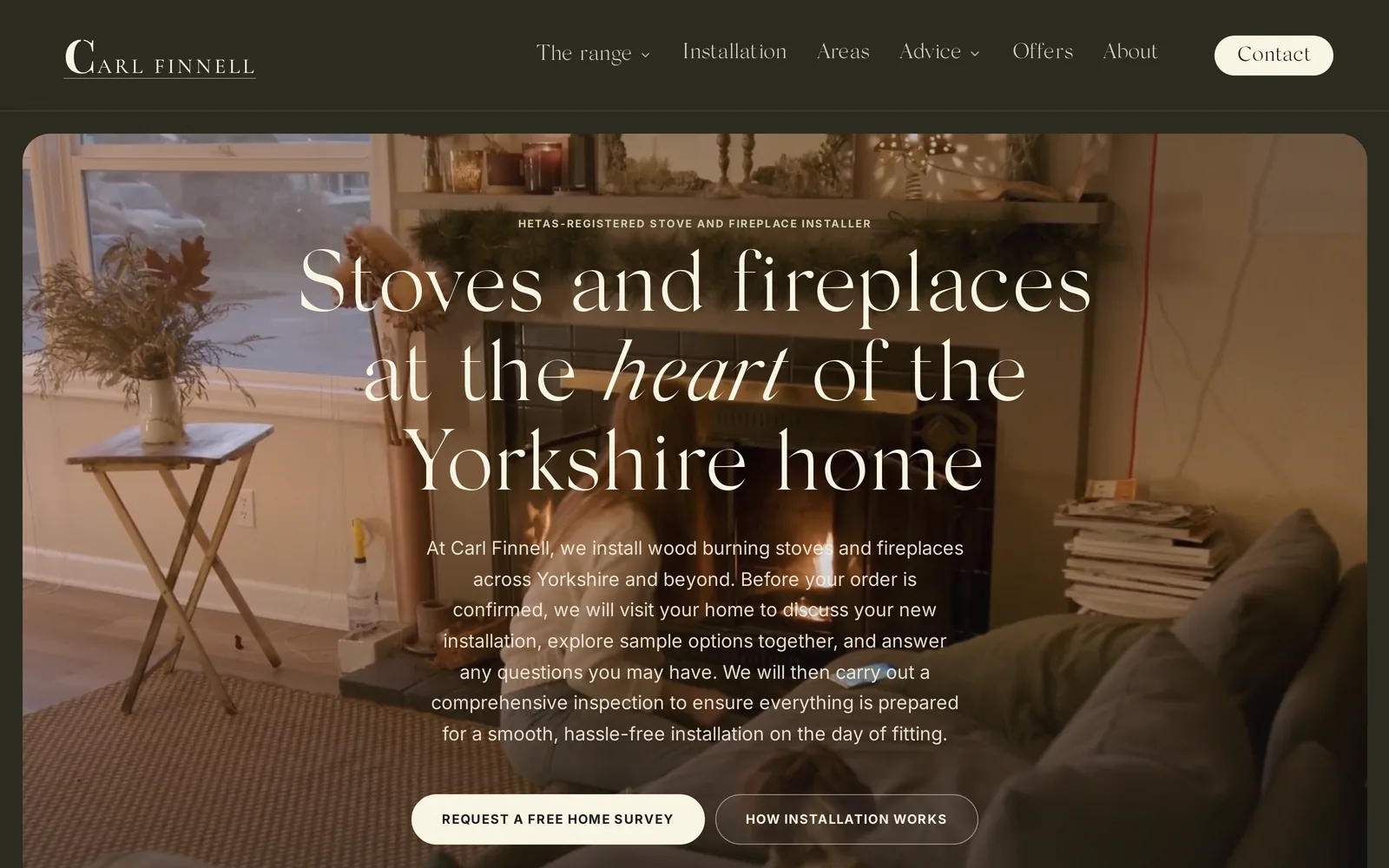
Carl Finnell is a HETAS-registered wood burning stove and fireplace installer based in Leeds, working the corridor out to the Yorkshire coast.
Carl Finnell is a HETAS-registered wood burning stove and fireplace installer based in Leeds, working the corridor out to the Yorkshire coast. He fits; Chris Davison handles enquiries, surveys the home, shows samples and closes the order. A competitor had quoted five thousand pounds for a one-off build, which was more risk than a two-hander wanted to take on an unproven website. The commercial problem was harder than the budget one. A stove is a slow, considered, several-thousand-pound purchase that nobody buys online, and the sector's search landscape is dominated by showrooms with premises and stock. Carl has neither, and cannot compete on 'come and see our display'. He competes on the survey: somebody comes to your house, looks at your actual chimney, and tells you the truth. The site had to make that visit the obvious next step, and had to earn the traffic to offer it to.
Client
Carl Finnell
Industry
Wood burning stoves & fireplace installation
Duration
Ongoing
Pages live
Town pages
Case studies
Guides
Service x town pages
A fire is not
a product decision.
Carl Finnell is a HETAS-registered stove and fireplace installer based in Leeds, covering the corridor out to the Yorkshire coast. A stove is a big, slow, emotional purchase, so the homepage opens on video of a real fire rather than a product grid, and the only thing it asks for is a home survey. Nothing on the site tries to close the sale. The survey closes the sale.
carlfinnell.com, the video hero
Every page on this site has one job: get somebody to book the free home survey.
Chris visits the property, looks at the chimney, shows samples and writes one clear quote. That visit is where this business wins, so the entire 193-page structure funnels into it. Product pages, town pages, guides and case studies all end in the same place. No basket, no instant price, no configurator pretending it can quote a flue it has never seen.
42 stoves and fires.
Every one with an opinion.
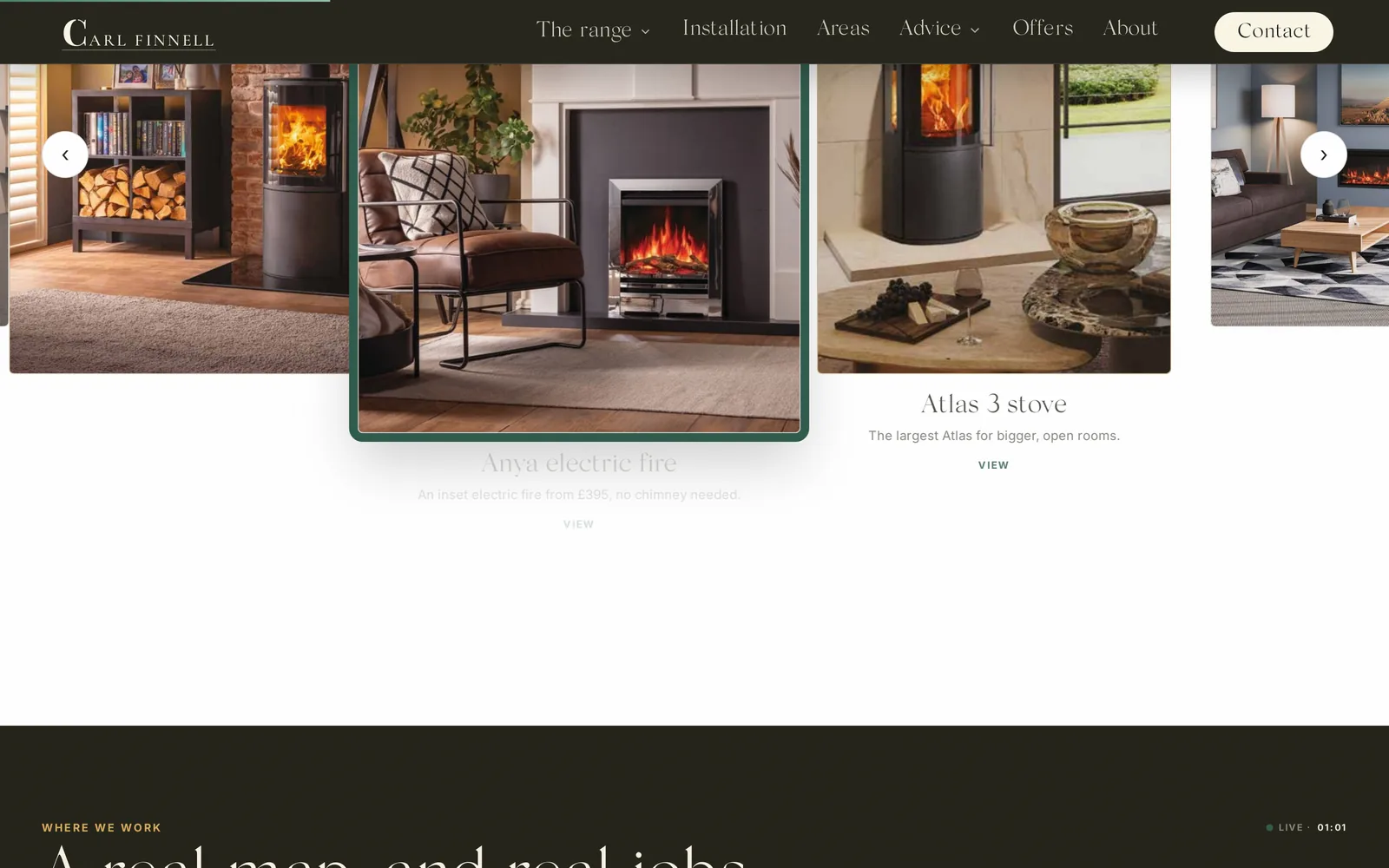
21 wood burning stoves and 21 electric fires, each on its own page. Not spec dumps: who the model suits based on its real output and working range, what fitting it involves, and an honest comparison against its own siblings. The Atlas 3 page tells buyers it is often too big for the room they have in mind. The larger Woodpecker page says when the cheaper model is the better buy. Turning away the wrong sale is what makes the right one credible.
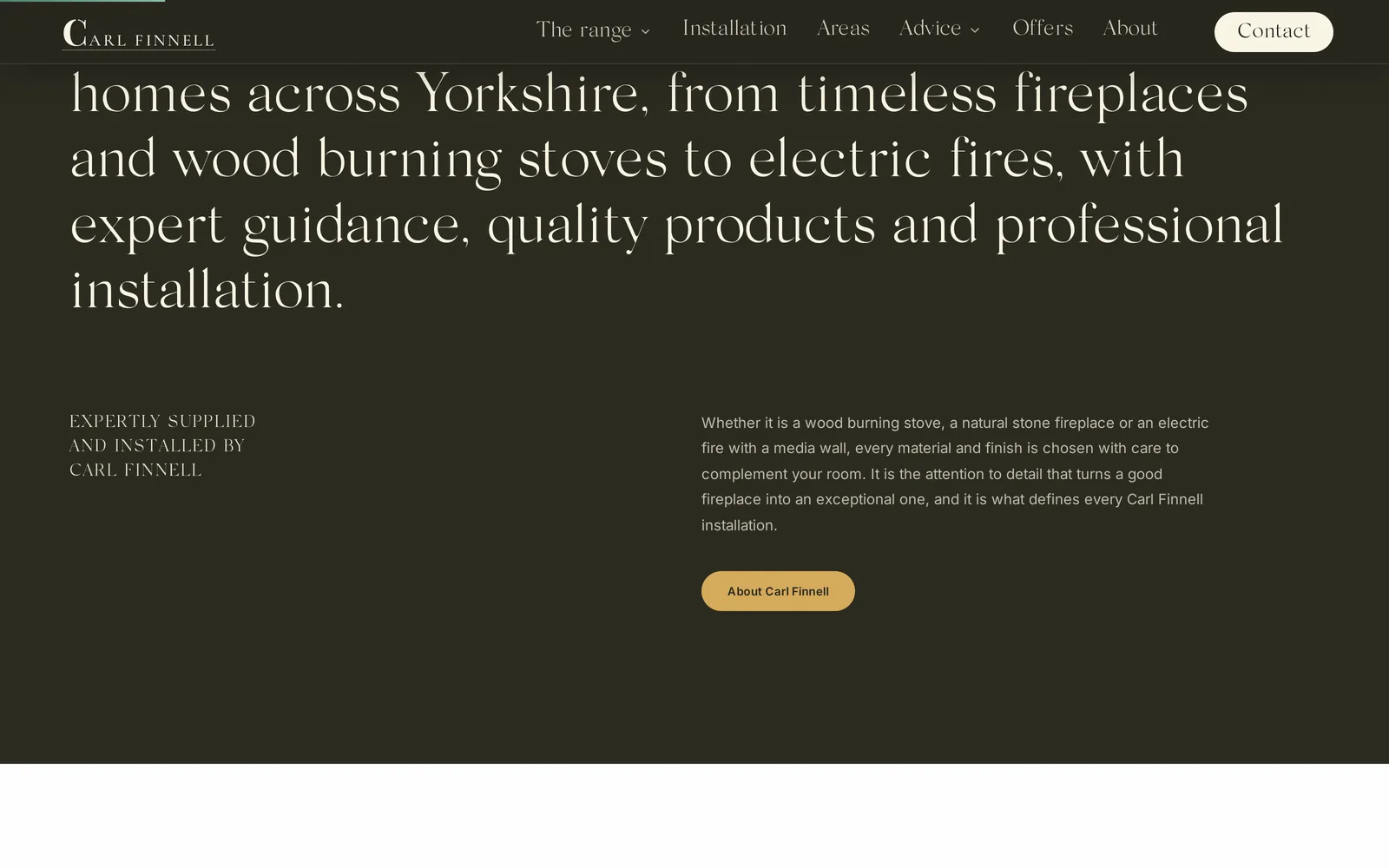
42 stove and fire pages, written like a survey conversation
23 town pages, then 12 more for the four towns worth fighting hardest for.
Every town in the corridor gets a hub page written around its own housing stock, chimneys and smoke control position. On top of that sit 12 focused service-by-town pages for Leeds, Harrogate, York and Wetherby, crossing stove installation, fireplace installation and chimney liner installation. Each one is install-focused and genuinely different from its hub, verified page by page before the next stage was built.
27 case studies.
All real installs.
Scarcroft, Nether Poppleton, Menston, Wetherby, Helmsley, a barn conversion at Earby, a sweep and service near Malton, a Spartherm Linear Triple in York. Every one is a job Carl actually did, photographed on the day, written up with the stove, the hearth, the flue work and the reason for each decision, then pinned to the town page it belongs to. Nothing on this site is a stock photograph of somebody else's fireplace.
Real jobs, attached to the towns they happened in
15 guides, written to be quoted by an AI assistant as much as ranked by Google.
What does a stove installation cost. Do you need a chimney liner. What size stove do I need. DEFRA exempt stoves and smoke control areas. Why use a HETAS-registered installer. 316 versus 904 liner. Answer-first, honest about price, honest about when the answer is 'it depends on your chimney', and every one of them ending at the survey.
Read in the room
the stove is going in.
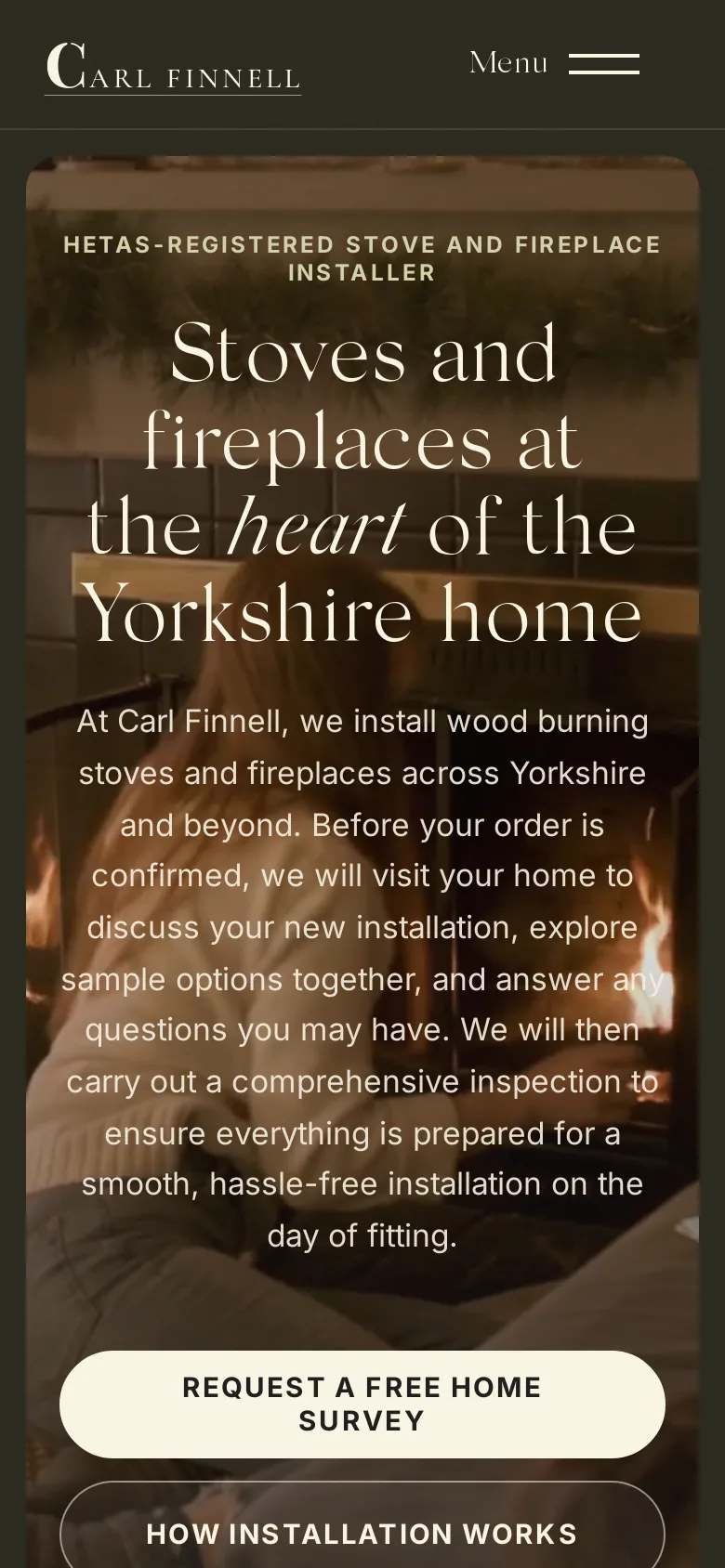
People research stoves standing in the living room, looking at the chimney breast, phone in hand. The mobile build keeps the video hero, the live coverage map and the survey request intact rather than stripping them out, and puts the tracked phone number one tap away on every page.
No invented jobs, no absolute claims, no gas.
Every case study is written from what is actually in the photographs and the fitting notes. Smoke control wording is address-specific rather than blanket, because parts of York are covered today with the rules extending city-wide from November 2026 and a blanket claim would be wrong. Insurance and warranty language says 'may' where 'may' is the truth. A trade site that overclaims gets found out on the survey.
How the build came together, in detail.
The brief, in one paragraph
A HETAS-registered stove and fireplace installer in Leeds, working out towards the coast, with a two-person operation: Carl fits, Chris surveys and sells. A competitor had quoted five thousand pounds for a one-off site. What Carl needed was not a brochure but a machine for filling Chris’s diary with home surveys, and a search footprint big enough to keep filling it.
Why the survey is the whole strategy
Nobody buys a wood burning stove from a website. The price runs into thousands, the installation depends entirely on a chimney nobody has looked at yet, and the decision is as much about how a room will feel as about kilowatts.
What does happen online is that somebody decides who to let into their house.
So the site never tries to close. It has no basket, no instant quote calculator, no configurator pretending it can price a flue it has never seen. Every page, whether it is a product, a town, a guide or a case study, ends at the same place: request a free home survey. Chris comes out, looks at the chimney, brings samples, answers questions, and writes one clear quote.
That is the client’s own offer and their own wording, and it is the strongest thing they have. The entire 193-page structure exists to hand people to it.
What is actually on the site
The current build, counted from the live sitemap:
- 42 core stove and electric fire product pages: 21 wood burning stoves and 21 electric fires
- 23 town pages, from Leeds and Harrogate out through York, Wetherby, Ripon, Malton, Thirsk, Northallerton, Selby and on to Scarborough, Filey and Driffield, plus Skipton to the west
- 12 service-by-town pages for the four priority markets
- 27 case studies, every one a real install
- 15 guides
- Service pages for installation, fireplaces, timber surrounds, stone fireplaces, stove chambers, beams, flues and chimney liners, servicing and accessories
- An offers section, data-driven so new offers are quick to add
- A live coverage map on the homepage with gold pins on towns where there is a real job to show, each pin opening a photograph of the actual install and linking through to the town page or the case study
The content depth programme
The first version of this site had the right structure and thin pages, which is the normal state of a new trade site and the thing that quietly caps it.
Town pages were sitting at around 650 to 720 words with up to 81% verbatim overlap between neighbouring towns. That is doorway page territory and Google treats it accordingly. Product pages were 400 to 550 words with sibling overlap as high as 88%, because two stoves in the same family had almost nothing distinguishing them written down.
The fix was a run of content phases, each built on a data layer so the templates never had to be touched twice:
Towns. Every one of the 23 rewritten around its own housing stock, chimney types and local conditions. Scarborough gets downdraught, salt air and holiday lets. Knaresborough gets conservation areas and gorge chimneys. Wakefield gets media walls. Each town carries five unique FAQs, and there are no duplicate questions anywhere across the set.
Products. All 42 rewritten as advice rather than specification: who the model suits based on its real output and working range, what the installation involves, and an honest comparison against its actual siblings. Every price reference was stripped out of the advice copy so the catalogue stays the single source of price truth and nothing goes stale.
Case studies. Two expansion passes, the second one working strictly from facts already on the page plus catalogue specifications. No invented job details, ever.
Guides. Fourteen now, each answer-first with Article and FAQPage schema.
The tier-1 combo pages
The 23 town hubs are the broad local layer. On top of them sit 12 focused service-by-town pages for the four towns worth fighting hardest for: Leeds, Harrogate, York and Wetherby, each crossed with wood burning stove installation, fireplace installation and chimney liner installation.
They were built in four stages, and every stage was verified before the next one started. The checklist each page had to pass:
- Title 60 characters or under, leading with the term and the town
- A single H1 carrying the exact head term and town
- 900 words minimum, and genuinely different from the town hub rather than a rehash of it
- Honest local specifics, real housing and chimney detail, no invented facts
- Service schema with areaServed set to the town, referencing the canonical business entity, plus FAQPage and BreadcrumbList
- At least four in-body internal links, and cross-linking both ways with the hub and the parent service page
- A unique FAQ set with no duplicate questions anywhere on the site
All 12 passed. Across the set, overlap with the parent town hub measured between 24% and 27%, which is essentially shared template and navigation rather than shared body copy, and the 60 FAQs across the 12 pages contain no duplicates and none shared with any hub.
The Leeds pages are the clearest example of why honest local detail matters. Leeds is a smoke control area, so those pages carry a DEFRA-exempt stove point, and they say plainly that a liner does not make a stove legal in a smoke control area. That is the kind of sentence a showroom site avoids and a homeowner remembers.
Proof, pinned to place
27 case studies, and every one is a job Carl actually did.
An ACR Rowandale in Scarcroft with a before and after. A York stone hearth at Nether Poppleton. A limestone fireplace at Menston. A Poppy corner stove with a shaped granite hearth and an external flue at Wetherby. A Spartherm A8 tunnel stove at Helmsley. A Contura 620 in a barn conversion at Earby. A chimney sweep and stove service near Malton. A Spartherm Linear Triple in York.
Each one is written up with the stove, the hearth, the flue work and the reasoning behind the choices, photographed on the day, with search-friendly image names and Article schema. Then the in-town ones are attached to their town pages, so somebody reading about Leeds sees a real Leeds job rather than a claim about coverage.
That single move does two things at once. It is the strongest trust signal a trade site can carry, and it is genuinely local content on the pages that need it most.
The honesty rules
A trade site that overclaims gets found out on the survey, which is the worst possible moment. So the writing runs to a set of standing rules:
- Smoke control wording is address-specific. Parts of York are covered today, with the rules extending city-wide from November 2026, so the site says the address gets checked on the survey rather than making a blanket claim about a city.
- Insurance and warranty language says “may”. Insurers may ask for proof of regular sweeping after a chimney-related claim. Some warranties require maintenance. That is what is true, so that is what it says.
- No prices in advice copy. The catalogue holds prices. The advice defers to the written quote after the survey.
- Honest steers. The Atlas 3 FAQ says it is often too big for the room people have in mind. Product pages tell buyers when the cheaper sibling is the better purchase.
- No gas, no invented facts, British English, no em-dashes.
Measurement, and a lead engine that runs itself
The site is connected to GA4, the sitemap is submitted to both Google and Bing, and a tracked mobile number runs on the site and the Google Business Profile with matching details, routed to Chris with a voicemail fallback and missed-call text-back.
Behind it sits a GoHighLevel lead engine on an enquiries and installs pipeline: an instant internal notification when any of the three forms is submitted, a single quote follow-up if a quote is still sitting unanswered after four days, and an after-install review request that stops the moment somebody replies. Nothing nags, everything stops on response.
Reviews and a consistent name, address and phone on the Business Profile are the two biggest local ranking levers a newer site has, and this closes both.
The audit that reset the plan
In July I built the site, audited every generated HTML file in the output, and wrote the findings up page by page.
That is a deliberately unflattering way to work, because it measures what is live rather than what the work log claims. It found real gaps: commercial pages under the word count standard, meta descriptions running long, oversized homepage imagery and missing image dimensions, thin new surround pages, case studies wanting another pass, and a redirect-style page that should not have been in the crawl path.
Those are now the queue. I would rather run a programme against a measured baseline with the problems written down than against a report that says everything is fine.
What’s next
- Image performance across the homepage and the electric fire pages, the biggest measured win left
- Bringing the remaining commercial pages up to the depth standard, working down the audit list
- Mapping the Google Business Profile service taxonomy into page clusters rather than chasing one page per term
- Off-site: citations, review collection through the lead engine, and the local trust signals the site cannot generate on its own
- More real installs, because every job Chris photographs is another case study and another town made credible
PLAINLY PRICED
Want me to look at your website?
Tell me what kind of site you need. I come back within a working day with a clear price, scope, and next step, straight from me, the person who’ll be doing the work.
A one-off £1,200 to design and build it. Then £199 or £299 a month to keep it working.