2026●KRT Prints●Rotherham, South Yorkshire
A 256-page printing and embroidery site with a full browsable catalogue and a South Yorkshire local search footprint.
KRT Prints is a print and embroidery studio in Rotherham with a real local reputation and, before this build, almost no way for a stranger to find it.
KRT Prints is a print and embroidery studio in Rotherham with a real local reputation and, before this build, almost no way for a stranger to find it. The difficulty with print is breadth. Kenneth sells printed workwear to builders, embroidered polos to salons, club hoodies to dance schools, memorial tees to families, mugs and business cards to anyone who walks in. Every one of those is a different search, a different budget and a different level of urgency, and a single 'we do printing' page loses all of them. On top of that, buyers want to see the actual garment. A print site with no catalogue asks people to imagine what they are ordering, and most of them go and find a national site that shows them instead.
Client
KRT Prints
Industry
Custom printing & embroidery
Duration
Ongoing
Pages live
Catalogue products
Service x town pages
Service pages
Sector pages
A print shop that
looks like a print shop.
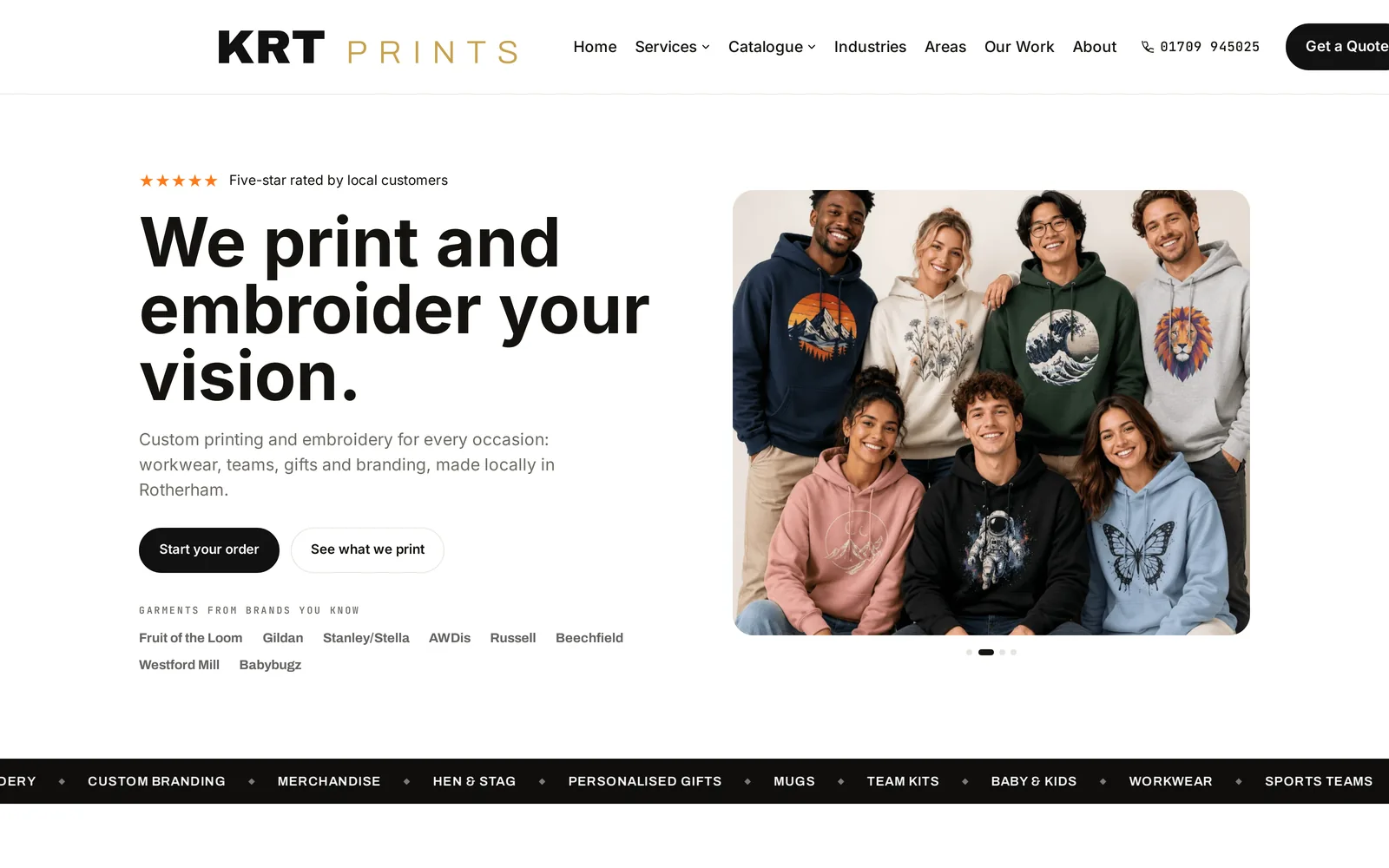
Kenneth prints and embroiders out of a studio in Rotherham. Workwear, team kits, hen and stag, memorial hoodies, baby and kids, mugs, business cards, banners. The homepage had to carry all of that without turning into a menu, so I led with one line, one photograph of real finished work, and a scrolling band of the jobs the studio actually takes. Everything else waits its turn.
krtprints.co.uk, the homepage
Nobody searches for 'printing'. They search for the exact thing they need printed, in the town they live in.
A print and embroidery studio sells hundreds of different things to a dozen different kinds of buyer. A builder wants hi-vis with a logo on the back. A dance school wants club hoodies for thirty children. A family wants ten memorial tees for a funeral. Those are three different searches, three different mindsets, and one generic 'services' page serves none of them.
159 products.
Every one a page.
The catalogue is the spine of the build. 159 individual garment and print products, each on its own URL with its own copy, its own imagery and its own structured data, grouped into 13 browsable categories. Fruit of the Loom, Gildan, Stanley/Stella, AWDis, Russell, Beechfield, Westford Mill and Babybugz all sit in the same system. A visitor who knows they want a heavy blend hooded sweatshirt can land straight on it from search rather than being dropped on a homepage and asked to hunt.
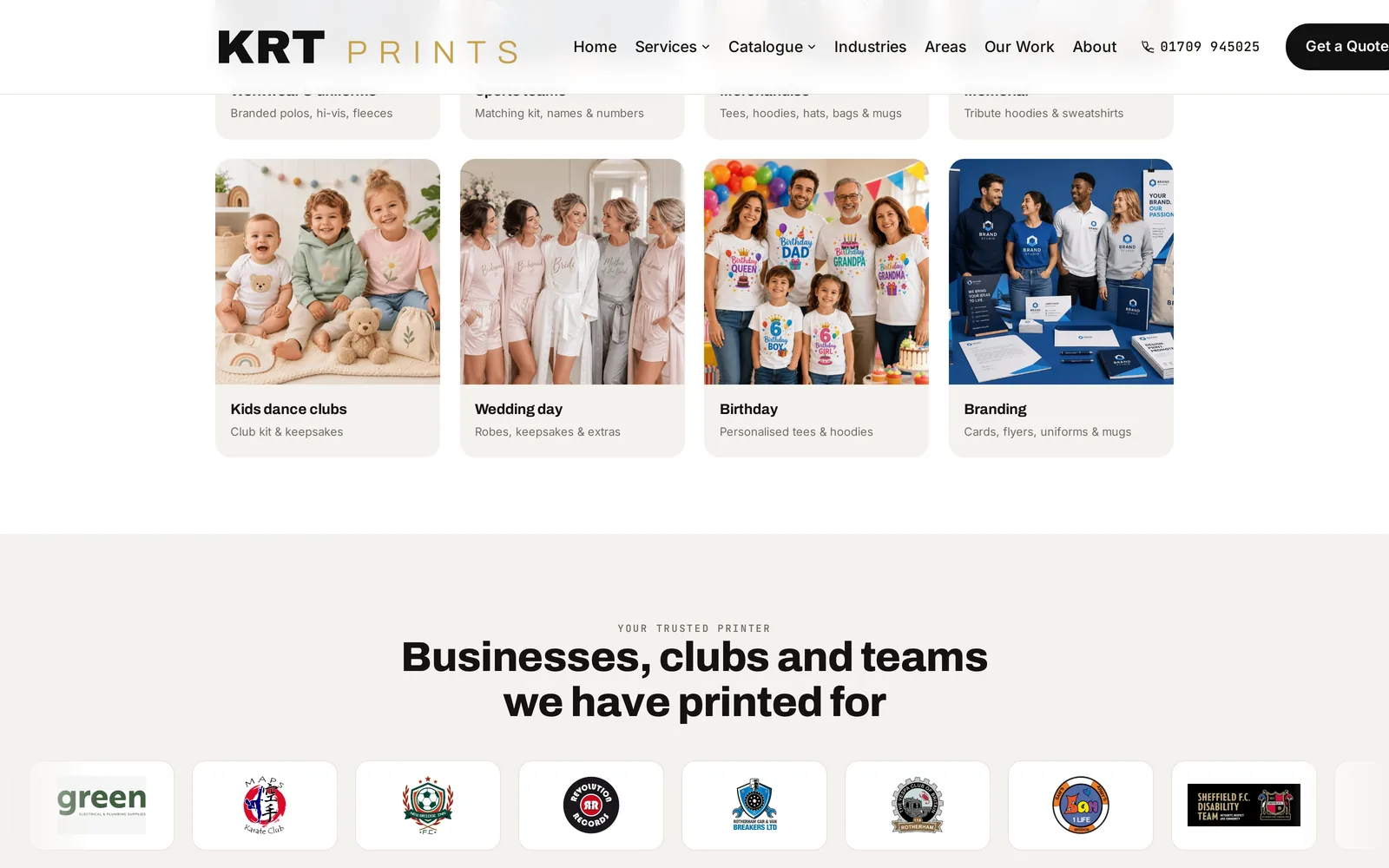
13 categories, 159 products, all on their own URLs
Eight sectors.
Eight different buyers.
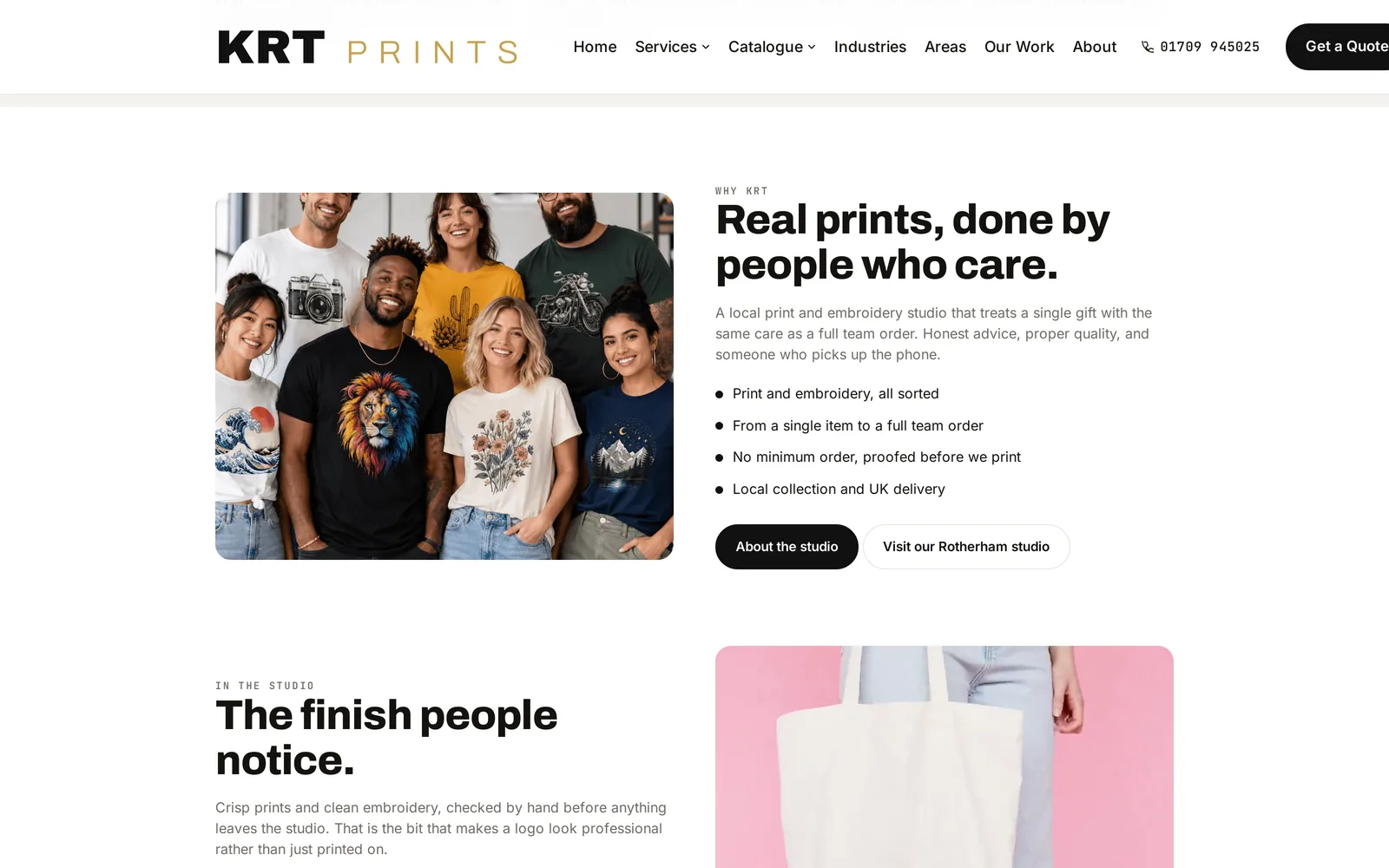
Martial arts clubs, gyms and fitness, hospitality, trades and construction, salons and beauty, care and healthcare, schools and education, charities and events. Each gets its own page, written for how that trade actually buys: a builder cares about hi-vis compliance and wash durability, a salon cares about how a logo sits on a black tunic. The sector pages let the site speak to a buyer in their own language instead of averaging everyone into one paragraph.
Sector pages, written per trade
Rotherham, Sheffield, Barnsley, Doncaster. Four towns, four services, twenty pages that did not exist before.
I built a service-by-town layer over the top of the catalogue: embroidery, workwear printing, custom t-shirts, sports team kits and business printing, each crossed with the four South Yorkshire towns KRT actually delivers to. Alongside those sit 13 flat local landing pages for the phrases people genuinely type, things like 't-shirt printing Rotherham' and 'personalised gifts Rotherham'. That is the part a template site never has.
Most orders start
on a phone.
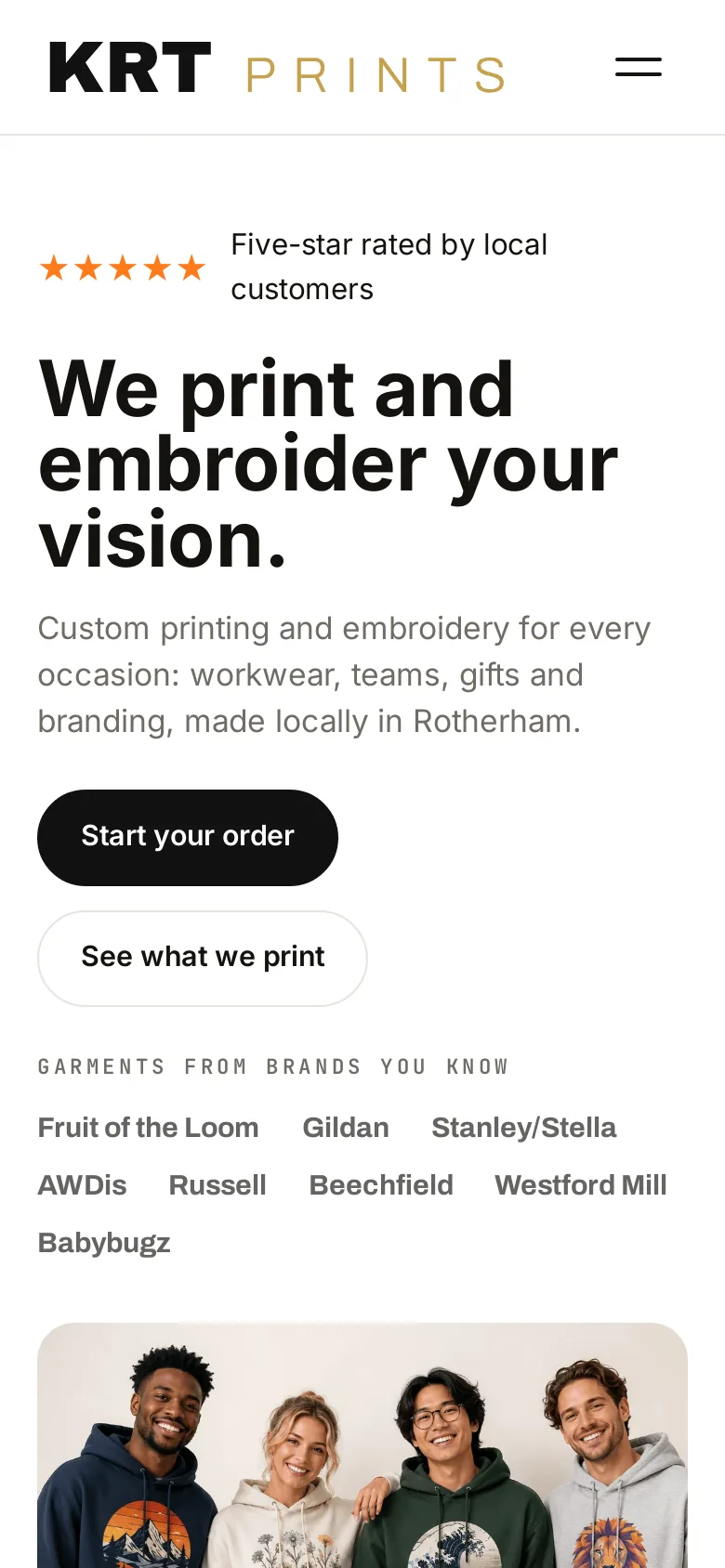
A team manager works out they need twenty shirts on a Tuesday evening, on the sofa, on a phone. So the mobile build leads with the phone number and the quote button, keeps the catalogue thumbable rather than cramped, and never asks anyone to pinch and zoom a product grid built for a desktop.
The proof was already
there. It just wasn't online.
KRT had years of goodwill in Rotherham and almost none of it visible in search. These are real reviews from named customers, pulled onto the site and marked up as Review schema tied to the LocalBusiness entity, so they work in the search results as well as on the page. Nothing invented, nothing padded.
This shop is brilliant, had great service every time. Kenneth is very helpful and nothing is too much trouble. Being very impressed with quality every time I have had a t-shirt printed here, definitely recommend.
I could not be happier with the service. It was a last minute desperate attempt as I needed the T-shirts ASAP! I am so so happy I came across KRT, excellent customer service.
Just had my 2nd order with KRT Prints, work shirts, fleeces and hats. This business is fantastic, cannot recommend enough.
Excellent quality prints. Friendly service. I'd recommend them all day long.
Answer the question
before the phone rings.
Two guides sit outside the sales pages: how to supply artwork for t-shirt printing, and print versus embroidery for workwear. Both are questions Kenneth answers on the phone several times a week. Written down, they save him the call, they qualify the enquiry before it arrives, and they pick up informational search traffic that the product pages never would.

The homepage end to end
256 pages, and adding the next one is a single line in a data file.
Products, categories, services, towns, sectors and occasions are all data. The page, the navigation entry, the internal links, the schema and the sitemap entry all build themselves from it. KRT can add a garment brand or a fifth town without paying for a redesign.
How the build came together, in detail.
The brief, in one paragraph
KRT Prints is a custom printing and embroidery studio in Rotherham. Workwear, team kits, merchandise, personalised gifts, baby and kids, memorial clothing, print and branding. Kenneth had a strong local reputation, a phone that rang because people knew him, and essentially no presence in search. The job was to build something that could carry the full breadth of what the studio makes, show the actual products, and rank across Rotherham, Sheffield, Barnsley and Doncaster for the specific things people search.
Why the catalogue came first
Most small print sites make the same mistake. They write a services page that says “we print t-shirts, hoodies, polos and workwear”, they add a gallery of past jobs, and they stop.
The problem is that a buyer wants to see the garment before they commit. They want to know it is a Gildan heavy blend and not an unnamed blank. They want to know it comes in their colour, in kids’ sizes, in a women’s fit. A gallery of somebody else’s finished order does not answer any of that.
So the catalogue is the foundation of this build, not a bolt-on:
- 159 individual products, each on its own URL, each with copy, imagery and structured data
- 13 browsable categories: tees and vests, polos, sportswear, hoodies and sweatshirts, kids, workwear and hi-vis, caps and beanies, bags, gifts and homeware, small format print, large format and display, stickers and labels, promotional and packaging
- Real brands named, Fruit of the Loom, Gildan, Stanley/Stella, AWDis, Russell, Beechfield, Westford Mill and Babybugz, because a buyer comparing quotes cares which blank you are printing on
- Print and non-garment products in the same system, so business cards, flyers, roller banners, mugs and window stickers all behave like catalogue items too
That last point matters more than it sounds. KRT is not only a garment printer. Treating the print side as a second-class citizen would have thrown away half the search market.
The three ways people actually search
The site is architected around three different mental models, because buyers do not all arrive the same way.
By product. They know what they want. “Heavy blend hooded sweatshirt”, “hi-vis polo”, “roller banner”. The catalogue page is the landing page and it should answer them in one screen.
By job. They know the outcome, not the garment. “Workwear printing”, “sports team kits”, “hen party”, “stag do”, “memorial clothing”, “custom hoodies”, “design service”. That is the 14-page service layer, and it is written in the language of the job rather than the product code.
By trade. They identify as a type of buyer before they identify a product. A martial arts club, a gym, a hospitality venue, a building firm, a salon, a care provider, a school, a charity running an event. Eight sector pages, each written for how that trade buys, what they worry about, and what they usually order.
Most competitor sites in this sector serve exactly one of those three. Serving all three is most of the reason this build is 256 pages.
The local layer
This is where a one-studio operation gets to out-structure a national supplier.
A national print site will rank for “custom hoodies” all day. It will never rank properly for “embroidery Barnsley”, because it has nothing local to say and no reason to say it. That gap is the entire opportunity for a Rotherham studio.
So the site carries:
- 20 service-by-town pages, crossing embroidery, workwear printing, custom t-shirts, sports team kits and business printing with Rotherham, Sheffield, Barnsley and Doncaster
- 13 flat local landing pages for the phrasings people genuinely use, including t-shirt printing Rotherham, workwear Rotherham, embroidery Rotherham, printing shop Rotherham, personalised gifts Rotherham, sports team printing Rotherham, dance club clothing Rotherham, business printing Rotherham, and custom printing across the four towns and South Yorkshire as a whole
- 4 town hub pages giving each area a broader overview that links down into the service-by-town pages
- 6 occasion pages for birthday, wedding day, memorial, branding, merchandise and kids dance clubs, which is how a lot of the gift and keepsake work is searched for
Every one of those is a real page with its own content, not a template with a town name swapped in. That distinction is the difference between ranking and getting filtered out as a doorway page.
The reviews
KRT had years of goodwill in Rotherham that existed on Google and in people’s heads and nowhere else. I put the real ones on the site, with the customer’s name, marked up as Review schema and tied to the LocalBusiness entity so they can surface in the search results rather than only on the page.
No invented testimonials, no unattributed “a happy customer, Rotherham”. If a review is not real, it does not go on.
The guides
Two pieces of content sit outside the selling pages: how to supply artwork for t-shirt printing, and print versus embroidery for workwear.
Both exist because Kenneth answers those questions on the phone every week. Writing them down does three jobs at once. It saves him the call. It means the enquiry that does come through arrives better prepared, with usable artwork and realistic expectations. And it picks up informational search traffic from people who are still deciding, months before they are ready to order.
Why it is built the way it is
Products, categories, services, towns, sectors and occasions are all data entries. The page, the navigation slot, the internal linking, the structured data and the sitemap entry all generate from that data.
Adding a garment brand is one entry. Adding a fifth town is one entry, and 5 new service-by-town pages appear with their schema and internal links already correct. Adding a sector is one entry.
For a studio the size of KRT, that is the point. The site is not a thing that gets replaced in three years. It is a thing that grows a line at a time.
What’s next
- More catalogue depth on the products that convert, so the strongest sellers read like a proper spec sheet rather than a listing
- More guides, following the same rule: if Kenneth explains it on the phone more than once a week, it should be a page
- Continued review collection, because in local search the reviews and the pages compound together
- New towns as delivery reach grows, one data entry at a time
PLAINLY PRICED
Want me to look at your website?
Tell me what kind of site you need. I come back within a working day with a clear price, scope, and next step, straight from me, the person who’ll be doing the work.
A one-off £1,200 to design and build it. Then £199 or £299 a month to keep it working.