2026●Stronghold Recovery●Doncaster, South Yorkshire
A mobile sports therapy site built around a four-step enquiry quiz and eight Doncaster area pages.
Steven Mills runs Stronghold Recovery as a mobile sports massage and recovery service across Doncaster and the surrounding DN postcodes.
Steven Mills runs Stronghold Recovery as a mobile sports massage and recovery service across Doncaster and the surrounding DN postcodes. Mobile is a genuinely different business to a clinic, and it is awkward to sell on a website. Almost every competing site in the sector is built around an address: here is where we are, here is the parking, here are the opening hours. Steven's advantage is that there is no address, and a conventional therapist template would have flattened that into a line of small print. The second problem was the enquiry itself. People arrive sore, uncertain and often unfamiliar with what they are actually booking, because cupping, IASTM and assisted stretch are not household terms. A blank contact box asks somebody in that position to write a paragraph explaining a body part they cannot name, and most of them will not.
Client
Stronghold Recovery
Industry
Mobile sports massage & recovery
Duration
Ongoing
Pages live
Area pages
Treatment pages
Step enquiry quiz
Recover.
Come back stronger.
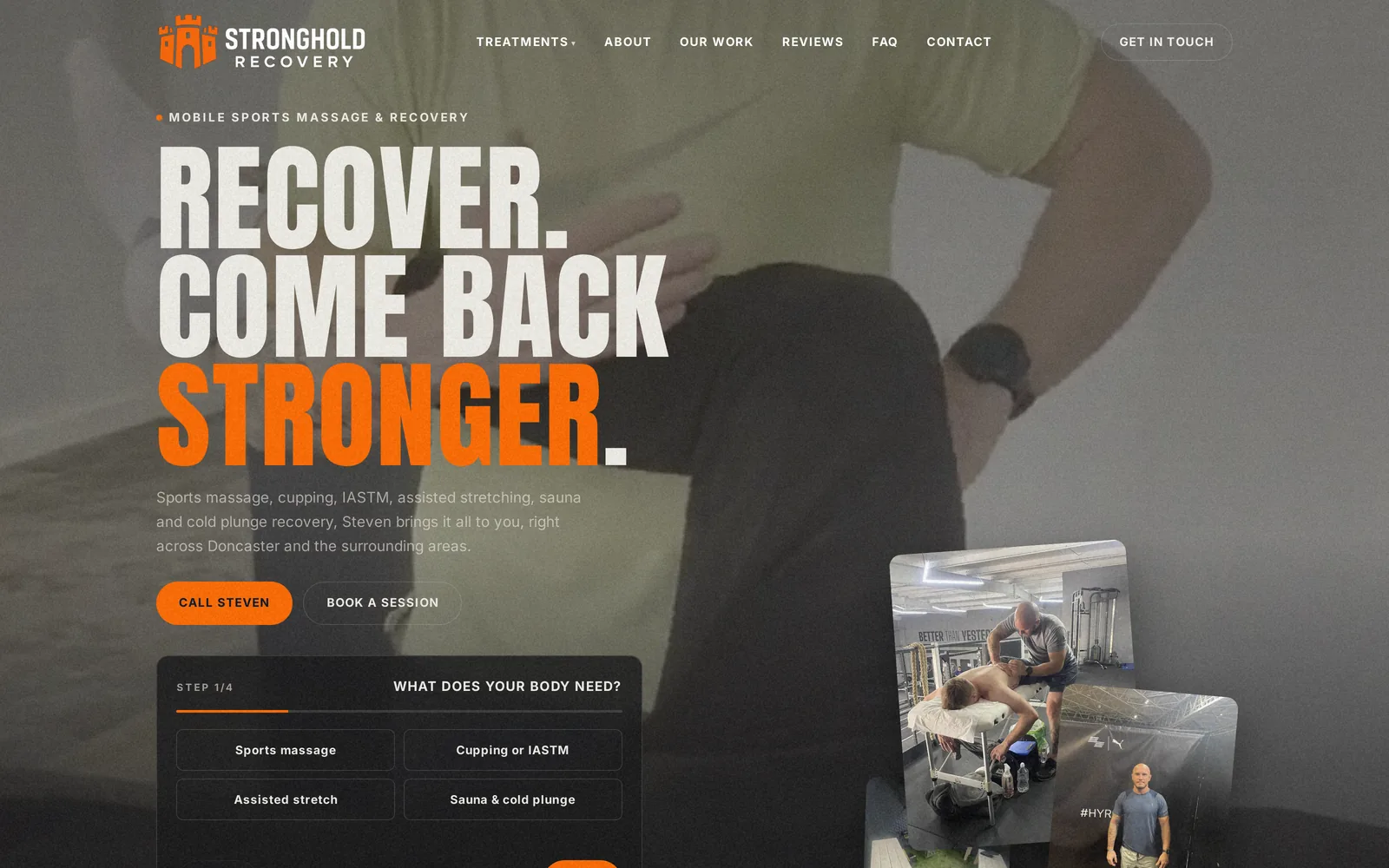
Steven Mills runs Stronghold Recovery out of a van rather than a clinic. Sports massage, cupping, IASTM, assisted stretching, sauna and cold plunge, brought to your house, your gym or your race day. The hero says the two things a visitor needs in one breath: what he does, and that he comes to you. Everything below it is proof.
strongholdrecovery.co.uk, the homepage
There is no clinic. The clinic parks outside your house.
Every competitor in this market has an address, and the address is the whole pitch: come to us, here is the parking, here are the opening hours. Steven has the opposite proposition, and a site built on the standard template would have quietly buried the only thing that sets him apart. So mobile is not a footnote here. It is the spine of the page, the navigation, the copy and the enquiry form.
Hands-on. Heat. Cold.
Movement.
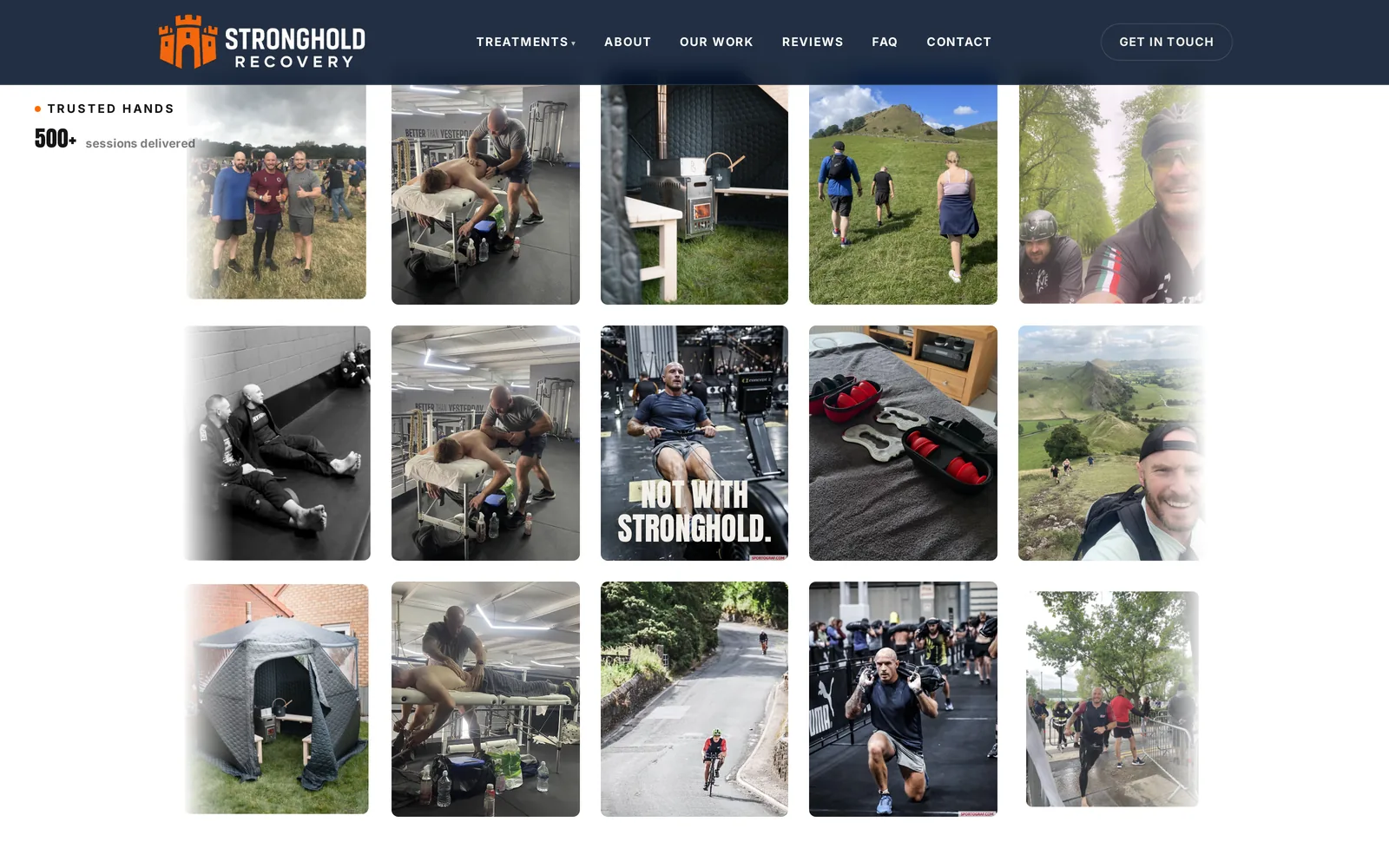
Sports massage, cupping, IASTM, assisted stretch, sauna and cold plunge, lymphatic drainage. Six treatments, six pages, each one explaining what it is, who it suits and what actually happens, because most people booking their first session do not know the difference between cupping and IASTM and will not admit it. Each page carries its own structured data and its own route into the enquiry.
Six treatment pages, written for a first-timer
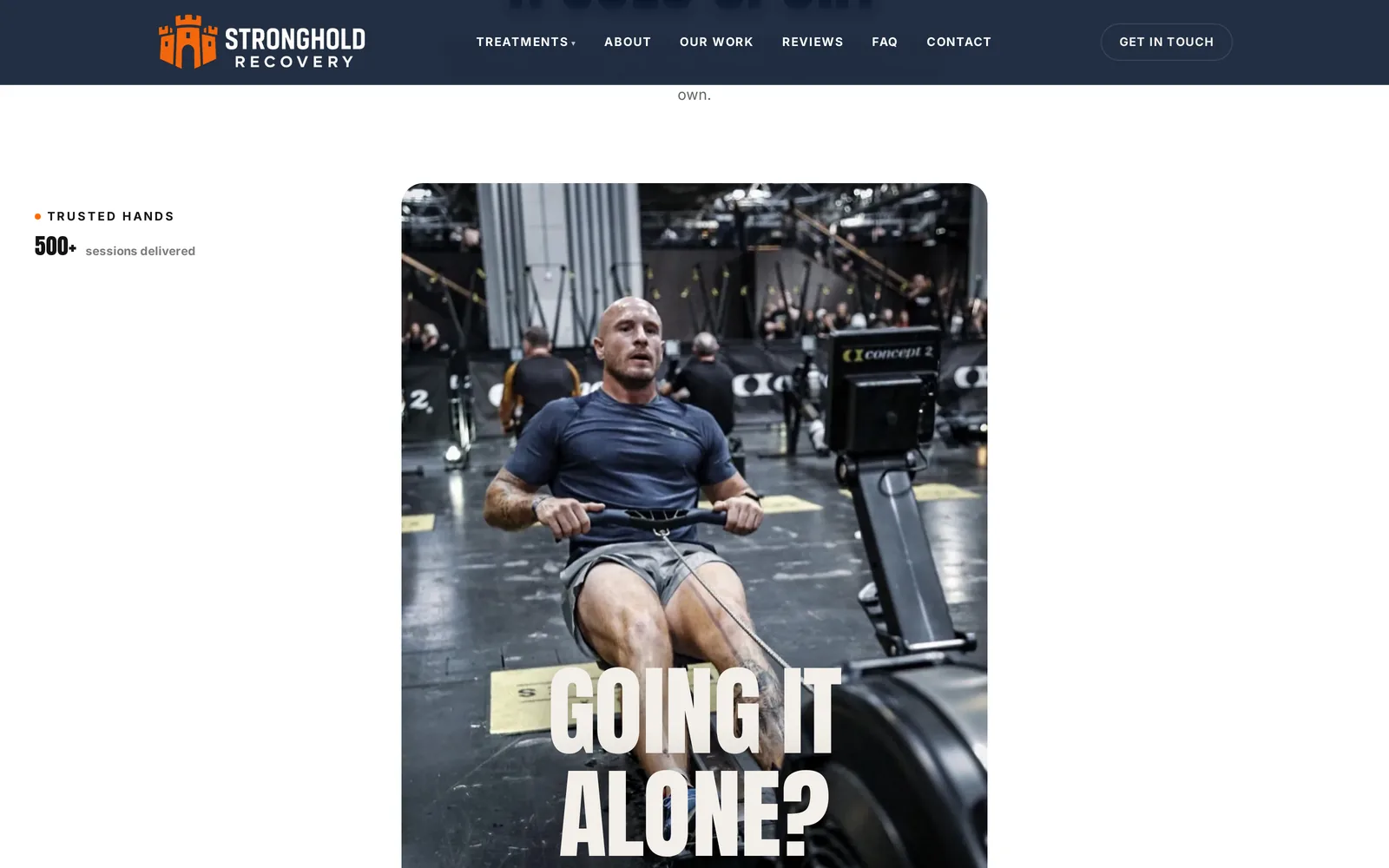
Eight years in the RAF Regiment, Ironman, Hyrox, and a dad. That is the pitch, and it is all true.
In a market full of interchangeable therapists, the biography is the differentiator. Steven is a Royal Air Force Regiment veteran with eight years' service, an Ironman and Hyrox athlete, Level 3 qualified in sports massage and RockTape and RockBlades certified. I gave that a proper section rather than a line in a footer, because it is the reason somebody picks him over the next name in the results.
Four questions,
not a blank box.
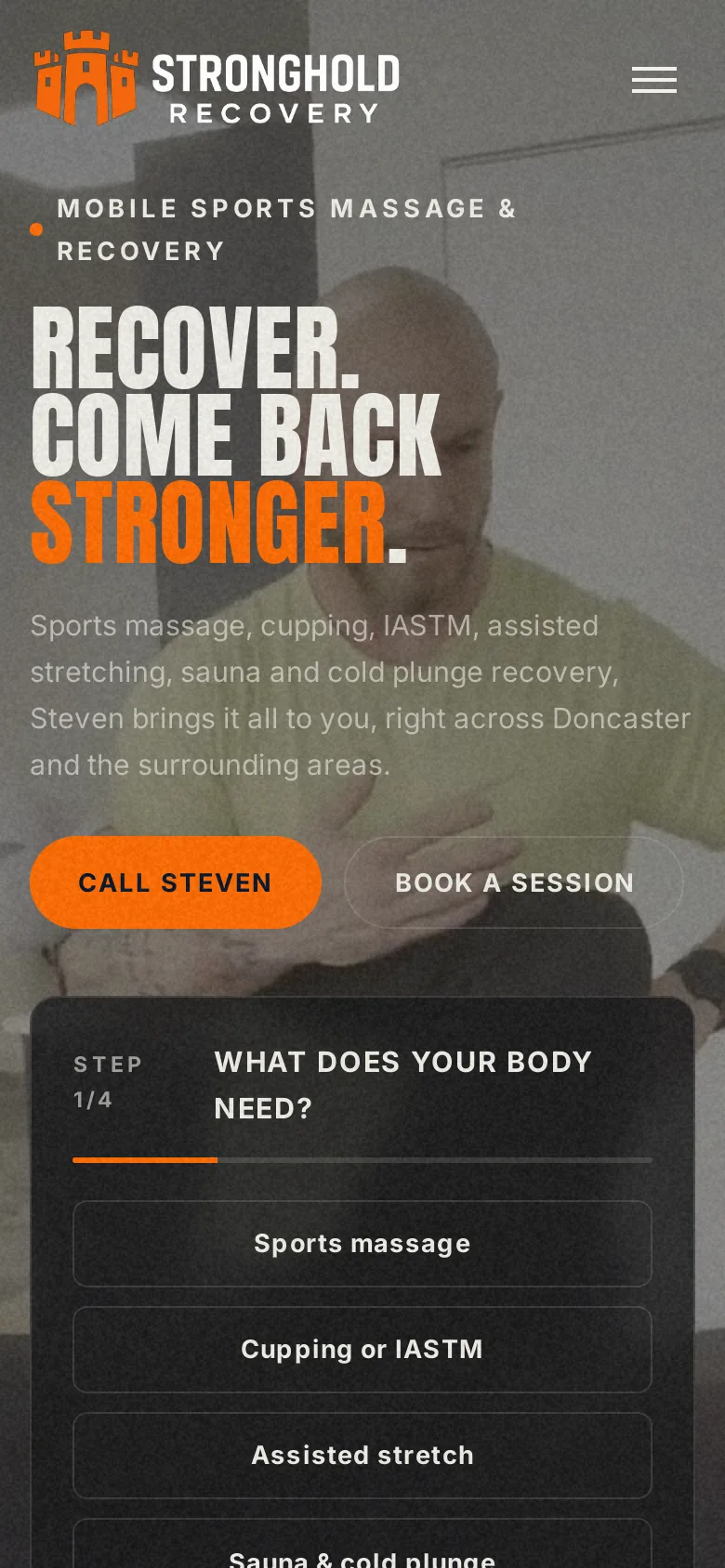
A contact form that says 'your message' gets abandoned, because the visitor has to compose something and does not know what to say. So the enquiry is a four-step quiz instead: what does your body need, where should Steven come to, what is the goal, and your details. Each answer is a tap. By the time Steven calls back he already knows the treatment, the location, the reason and the name, so the first conversation is a booking rather than an interview.
The four-step 'what does your body need?' enquiry
Doncaster is not one search. It is eight.
Bessacarr and Cantley. Armthorpe and Edenthorpe. Askern and Adwick. Balby and Warmsworth. Bawtry, Tickhill and Rossington. Bentley and Sprotbrough. Conisbrough and Mexborough. Thorne and Hatfield. Eight area pages grouped the way people in the DN postcodes actually think about where they live, each one a real page rather than a town name swapped into a template.
Booked from the sofa,
usually while aching.
Nobody books a sports massage at a desk. They book it on a phone, the evening after a hard session or the morning after a race, while the thing hurts. The mobile build leads with tap-to-call and WhatsApp, keeps the quiz to one thumb-sized decision per screen, and never puts a form field between somebody and the phone number.
The reviews section is built and waiting. It stays empty until the real ones land.
The site has a review wall ready to take genuine, named Google reviews, wired into the enquiry-to-review journey. Until Steven has collected them, it holds placeholders rather than invented praise. I do not write testimonials for clients, and a small business does not need fake proof when it has a real story.
How the build came together, in detail.
The brief, in one paragraph
Steven Mills is a mobile sports massage and recovery therapist covering Doncaster and the surrounding DN postcodes. No clinic, no waiting room. He brings the table, the tools and, when it is booked, an eight-person wood-fired sauna and a cold plunge to your house, your gym or your race day. He needed a site that made the mobile part the headline rather than the caveat, explained treatments that most first-timers cannot name, and turned browsers into enquiries he could actually work with.
Why “we come to you” had to be the spine
The default website for a therapist is built around a place. Address, map, parking, opening hours, a photo of the treatment room. Every one of Steven’s competitors has that site, and it works for them.
Steven’s whole advantage is that there is no room. He arrives, sets up in a couple of metres of clear floor, works, and leaves. For an athlete who has just finished a hard session, not having to drive home stiff afterwards is worth a great deal, and for a shift worker or a parent it is often the only way the appointment happens at all.
If I had built the standard site and put “mobile service available” in the header, the single strongest thing about the business would have been the least visible thing on the page. So it runs everywhere: the hero, the sticky call bar, the navigation, a dedicated section on how a home visit actually works, and the second question in the enquiry quiz.
The treatment pages
Six pages, one per treatment:
- Sports massage, the core of the business
- Cupping, including the honest answer about the marks
- IASTM, instrument assisted soft tissue mobilisation, which almost nobody can define
- Assisted stretch
- Sauna and cold plunge, the contrast recovery setup Steven brings to the address
- Lymphatic drainage
The writing rule on all six was the same: explain it before you sell it. The person reading has usually been told by a coach or a training partner that they should try this. They are not going to admit they do not know what it is. If the page explains it clearly and without jargon, they book. If it assumes knowledge, they close the tab and go and read a Wikipedia article instead, and then they book with somebody else.
Each treatment page carries its own structured data and its own route into the enquiry, so a search for the specific treatment lands on the specific page rather than the homepage.
The four-step enquiry
This is the piece I would keep if I could only keep one.
A conventional contact form asks for a name, an email and a message. The message box is the problem. Somebody who is sore, tired and unsure what they need has to compose a paragraph explaining a body part they cannot name to a stranger they have not met. A meaningful share of them simply do not, and the enquiry never happens.
So the hero carries a four-step quiz instead:
- What does your body need? Sports massage, cupping or IASTM, assisted stretch, sauna and cold plunge.
- Where should Steven come to? Town or postcode.
- What is the goal? Injury recovery, aches and tension, event or race prep, general recovery.
- Your details. Name and phone.
Three taps and a phone number. No typing until the last step, by which point the visitor has already invested enough to finish.
The payoff sits on Steven’s side. He calls back already knowing the treatment, the location, the reason and the name. That first conversation starts at “when suits you” instead of “so what seems to be the problem”, which is the difference between a call that books and a call that gets thought about.
The phone number and WhatsApp sit alongside the quiz throughout, because a decent share of people in this sector will always just ring, and making them fill in a form first is a way of losing them.
The local layer
Doncaster is not one search market. It is a city, a ring of large villages and a spread of DN postcodes, and people identify with their bit of it, not the whole.
So the site carries eight area pages, and they are paired the way people actually talk:
- Bessacarr and Cantley
- Armthorpe and Edenthorpe
- Askern and Adwick
- Balby and Warmsworth
- Bawtry, Tickhill and Rossington
- Bentley and Sprotbrough
- Conisbrough and Mexborough
- Thorne and Hatfield
Pairing matters. A single page per village would have produced a stack of near-identical thin pages, which is doorway territory and gets treated as such. Grouping them the way locals group them gives each page enough genuine substance to stand up, while still naming the specific place somebody typed.
The person is the product
In a market of interchangeable listings, the biography does more selling than the service copy.
Steven is a Royal Air Force Regiment veteran with eight years’ service, including tours of Iraq and Afghanistan. He is an Ironman and Hyrox athlete with a rugby background. He is Level 3 qualified in sports massage and certified with RockTape and RockBlades. He went mobile deliberately, because he had spent years driving home stiff after treatment and knew how much of the benefit that undoes.
That is a genuinely distinctive story and it gets a proper section on the homepage plus a full about page, not a line in the footer. Somebody choosing between three names in a search result is choosing a person to have their hands on them. Give them the person.
The FAQ that answers the awkward questions
The FAQ block is longer than most, on purpose. It covers what happens in a first session, where Steven travels, what cupping is and whether it hurts, what IASTM means, how the sauna and cold plunge work at a domestic address, how much it costs, how often to book, whether he treats injuries, and what space is needed.
Two of those deserve calling out.
Cost. Most sites in this sector dodge it. This one says plainly that it depends on the treatment and whether it is a one-off or a block, and that Steven will give a straight price with no obligation. That is more honest than a price list that goes stale and more useful than silence.
Scope. The FAQ says that anything needing scans, diagnosis or medical care will be referred on rather than treated. A therapist saying what they will not do is one of the strongest trust signals a site of this kind can carry.
The reviews, and what is not on the site
The site has a review wall built and wired, ready for genuine named Google reviews, and the enquiry-to-review journey is part of the ongoing work.
Until those real reviews land, it carries placeholders rather than invented praise. I do not write testimonials for clients and I do not put a rating on a site that has not been earned. A business with a real story does not need a fake one.
What’s next
- Collecting and publishing real Google reviews, then marking them up so they work in the search results as well as on the page
- More area depth as the round settles into its regular patch
- Content around the events Steven works, race days and club sessions, which is both proof and search traffic
- Tracking which of the four quiz routes actually converts, and shaping the treatment pages around the answer
PLAINLY PRICED
Want me to look at your website?
Tell me what kind of site you need. I come back within a working day with a clear price, scope, and next step, straight from me, the person who’ll be doing the work.
A one-off £1,200 to design and build it. Then £199 or £299 a month to keep it working.