Web design for tradesmen
Tradesman websites
built to win jobs.
Web design for tradesmen should not start with decoration. It should start with the job: get a real customer from Google, onto the site, convinced you are credible, and into a call, quote request or callback.
I build fast, phone-first websites for trade businesses that need clear services, honest proof, proper local SEO foundations and a Google Business Profile that lines up with the site.
If your trade sits around hearths, showrooms or installations, I have a separate page for fireplace and stove company web design.
What a trades website needs
A good tradesman website makes trust and contact obvious.
Fast on a phone, even on site
Most trade enquiries happen on a phone. Someone is stood in a kitchen, outside a house, or pulled over between jobs. If the site is slow, cluttered or awkward to tap, the enquiry goes somewhere else.
Clear services, not one vague list
A good tradesman website separates the work properly. Plumbing, rewires, roof repairs, stove installation, decorating, joinery and landscaping all need pages that say what is included and what the customer should do next.
The patch you actually cover
Service area matters. Google needs to understand where you work, and customers need to know whether you will come out to them. That can mean a regional hub, town pages, or a tighter local structure.
Quote and callback routes
A trades website should make it easy to call, request a quote, send photos or ask for a callback. If you are busy on the tools, the site and follow-up need to catch the lead while you get on with the job.
Reviews and real job photos
People want proof that you turn up, do tidy work and leave customers happy. Real job photos, recent Google reviews and short case studies beat stock images every time.
Google Business tied in
The site and the Google Business Profile should agree on services, area, phone number, reviews and wording. For local trades, that connection is often where the map pack work starts.
Where trades sites fail
The usual leak is not design. It is clarity.
Most weak trade sites fail before the customer gets near the contact form. They do not say the service plainly, they hide the phone number, they rely on a generic gallery, or they make the business look smaller and less organised than it is.
- Homepage copy that says everything and proves nothing.
- No phone number until the footer.
- A single gallery with no service pages behind it.
- Stock photos instead of real work.
- Town names listed in a paragraph with no proper local pages.
- Forms that ask too much before the customer has decided to trust you.
Honest trade proof
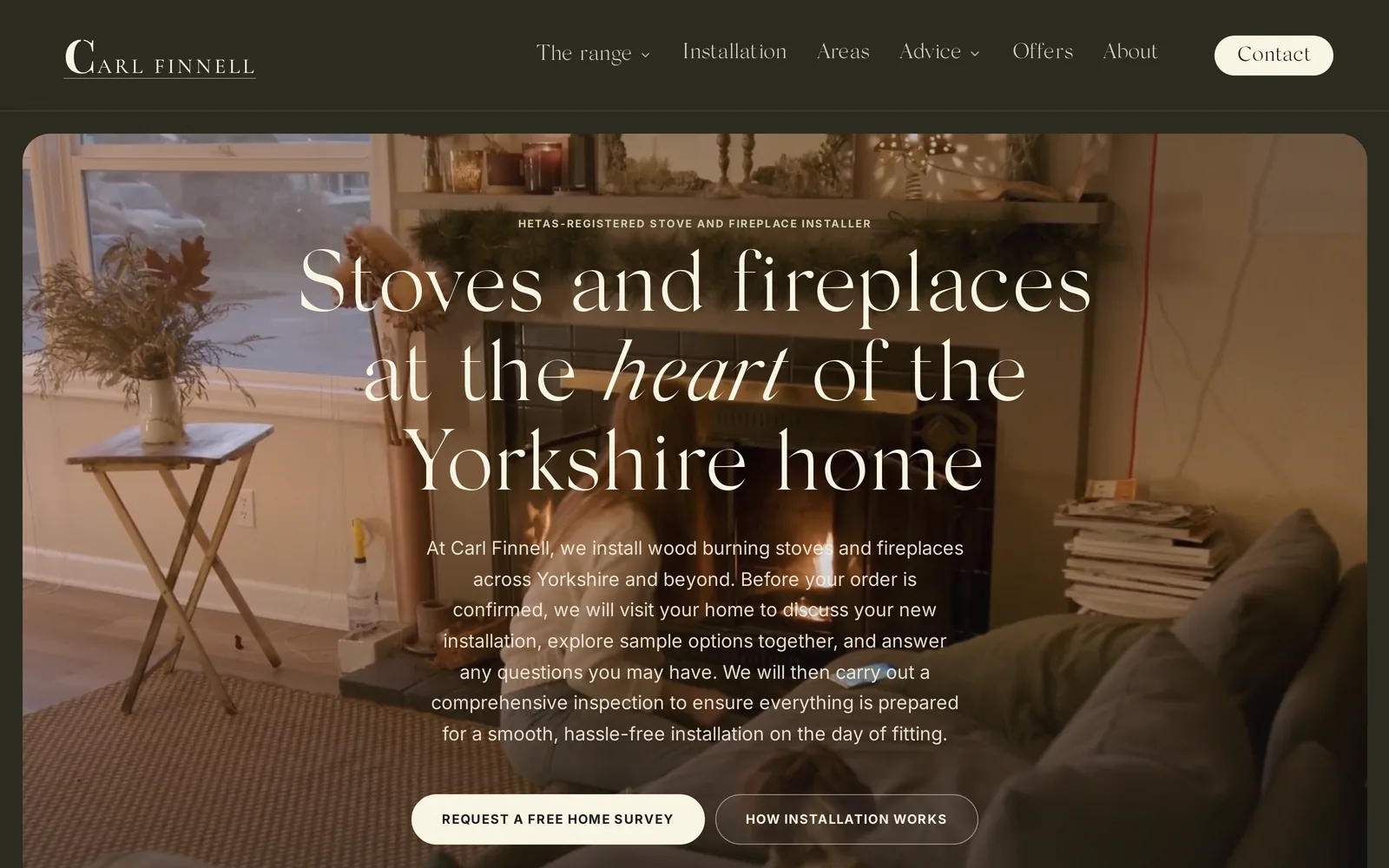
Carl Finnell is real trades proof, not a pretend logo.
Carl Finnell is a HETAS-registered stove and fireplace installer based in Leeds, working out towards the Yorkshire coast. The site is a 193-page build with town pages, service pages, real installation case studies, guides and a home-survey enquiry route. That is exactly the kind of depth a serious tradesman website can need when search is part of the job.
How Copper Lane builds them
The build starts with the enquiries you want.
I map the services first, then the areas, then the proof. That gives the site its structure before a design decision gets made. If the business needs town pages, they have to earn their place with useful local detail, not copied paragraphs.
The design is then built around phone use, quick trust, clear contact routes and search foundations. That means page titles, metadata, schema, internal links, Google Business Profile wording and a site that loads quickly without a heavy plugin stack.
For many trades, the monthly plan matters as much as the launch. Reviews, Google Business Profile work, new service pages, follow-up and field-note style content are what stop the website sitting still after it goes live.
Where this connects
Trade websites still need local pages.
The trades page is the national guide. The town pages are where local search gets sharper, especially across North Yorkshire and the edge towns Copper Lane already covers.
Web design for tradesmen, common questions.
Do tradesmen need a website or is Google Business enough?
+
A Google Business Profile is essential, but it is not enough on its own. The website gives Google and customers the detail: services, service areas, proof, photos, FAQs, reviews and contact routes. The two should work together.
What should a tradesman website include?
+
At minimum: clear services, a visible phone number, quote or callback form, service area, reviews, real job photos, Google Business alignment, and pages written around how customers actually search.
How much does a trades website cost with Copper Lane?
+
The current model starts with a one-off £1,200 design and build fee. After launch the site runs on a monthly plan, usually Growth or Local Pro, depending on how much local SEO work you need.
Can you build trade pages for more than one town?
+
Yes, when there is a real reason. A proper service area structure can cover priority towns, but each useful town page needs its own local angle and cannot just be the same copy with a place name changed.
Do you write the copy?
+
Yes. I write the structure and copy from a short conversation with you, your services, the jobs you want more of, the areas you cover and the proof you already have.
Need a tradesman website
that actually earns calls?
Send me the trade, the area and the jobs you want more of. I will tell you what the site needs before I tell you what it should look like.
Ask about a trades website ->